
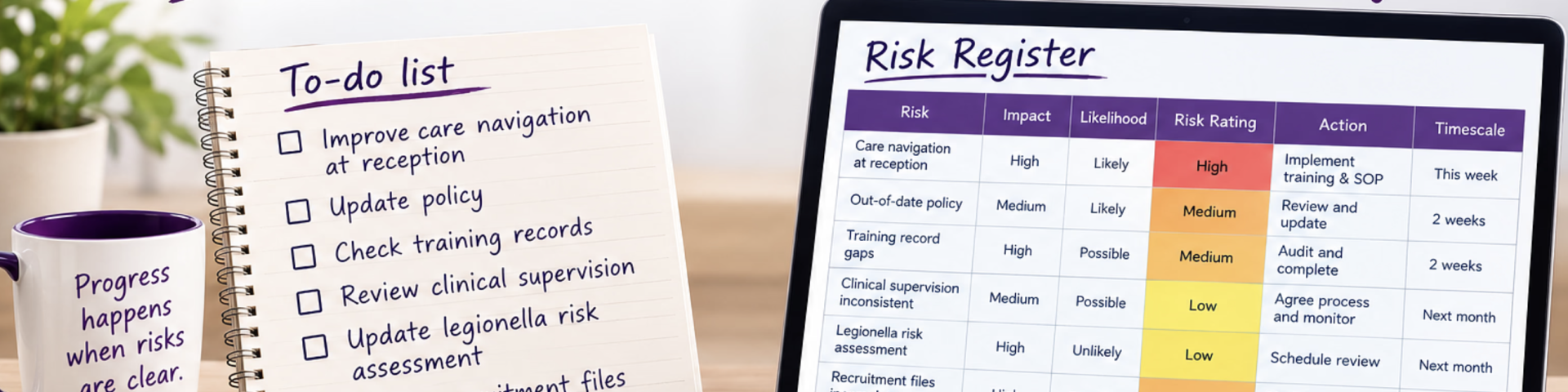
Every practice leaves a workshop with a to-do list. Ours turns into something different — a risk register.
The approach is deliberately pragmatic. You already know something isn’t where you want it to be. Reception muddling through care navigation. A policy that’s three years out of date. A training record with gaps nobody’s chased up. You don’t need to invent the risk. You step back, name what the risk actually is, and it goes on the register.
That’s a different exercise to standing in your waiting room trying to work out, from scratch, what could go wrong in the care navigation process at your front desk. One starts from something you already know. The other asks you to imagine a problem you haven’t found yet — which is slower, harder, and usually less accurate.
The payoff is prioritisation. A long to-do list treats every item as equally urgent, which in practice means nothing gets done in the right order — or anything gets done at all, because the list is too long to look at. A risk-ranked list doesn’t do that. It tells you what needs fixing this week, what can wait a fortnight, and what’s genuinely fine to leave for now — because you’ve judged it against the risk, not against how long it’s been sitting there making you feel guilty.
Not compliance theatre. A system your whole team can look at and know, in ten seconds, what matters most this week.
Join the free Harmony CQC community if you want to talk through how a risk register actually works in practice. If you want one built for your practice, start with The Simple Path.
Free Community:
https://hcqc.co.uk/freecommunity
The Simple Path: