
If you use Healthcare Assistants (HCAs) to help deliver flu, there’s a fair chance you’ll run this year’s clinics much the way you ran last year’s. Nothing on the ground looks any different, so why wouldn’t you?
But something has quietly changed, and it’s easy to miss: the guidance on consent has been made explicit — and it affects the route most practices already use. The short answer to “can an HCA give the flu jab?” is still yes. What’s changed is who has to take, and clearly document, the patient’s consent before they do.
If that hasn’t landed on your radar yet, you’re not alone — which is exactly why it’s worth a couple of minutes now, before your 2026/27 clinics start.
What has actually changed
The guidance on consent has been made explicit: only a registered healthcare professional (HCP) can obtain a patient’s informed consent to treatment.
An HCA can still prepare, give and record the vaccine — that part is unchanged. But the clinical assessment and the informed consent must be done, and clearly documented, by a registered clinician before the HCA administers.
Previously this was less clearly spelled out, and it was common and accepted for an HCA to confirm a patient was happy to go ahead before vaccinating. That was reasonable under the guidance as it stood. The position is now explicit, and it changes how the route most of us already use needs to run.
Here’s the catch: because nothing visible has changed in the room, the easy thing is to carry on exactly as before — and for a lot of practices, that’s precisely what will happen without anyone noticing. That’s the gap to close before flu season, and it’s a quick one to fix once you know it’s there.
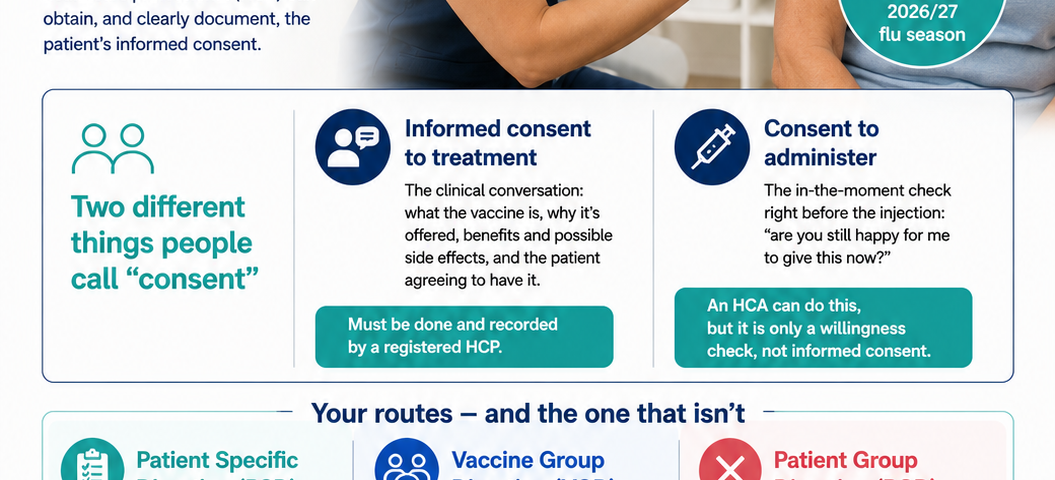
Two different things people call “consent”
This is the distinction that trips practices up. “Consent” gets used to mean two very different things, and only one of them can sit with an HCA:
- Informed consent to treatment — the clinical conversation: what the vaccine is, why it’s offered, the benefits and possible side effects, and the patient agreeing to have it. This needs clinical judgement and must be done, and recorded, by a registered HCP.
- Consent to administer — the in-the-moment check right before the injection: “are you still happy for me to give this now?” An HCA can do this, but it is only a willingness check. It does not replace, and is not, informed consent to treatment.
If the only “consent” that happened was an HCA asking “all right to go ahead?” at the point of the needle, the patient has not been properly consented.
Your routes — and the one that isn’t
There are three mechanisms in play, and the one you pick decides whether an HCA can vaccinate at all:
- Patient Specific Direction (PSD) — the route most practices already use. A registered prescriber assesses the named patient, takes and records consent, and directs the HCA to administer.
- Vaccine Group Direction (VGD) — new from April 2026. It lets an HCA vaccinate under a group direction, but it requires on-site supervision by the assessing clinician throughout the whole session.
- Patient Group Direction (PGD) — not an option for an HCA, full stop. A PGD is for registered staff only and allows no delegation. As we know, an HCA can never work under a PGD — but it’s worth stating for good measure.
For general practice, our steer is to stay with the PSD route. The VGD’s supervision rule ties a GP or nurse to the HCA’s clinic for the entire session, which removes the very time saving you were after — it was built for a mass-vaccination centre with one supervisor over many vaccinators, not a routine practice flu round. The PSD lets a prescriber assess and consent each patient in advance without pinning a clinician to the whole session — provided the consent step is verified and documented at the point of giving.
Why summer is the moment to sort this
Flu clinics feel a long way off in July. That’s exactly why now is the time to think it through. If HCAs are part of your plan for 2026/27, you’ll want a workflow that captures registered-clinician assessment and consent in advance, documents it clearly, and lets the HCA verify it at the point of giving — before the first patient is booked, not after.
Get that designed into your clinic over the quiet months and the season runs smoothly. Leave it to September and it becomes a scramble.
Get the full guide
We’ve pulled all of this into a free, plain-English practice guide for the EPC community: what’s changed, all three routes in detail (and why we still think the PSD is the better fit for general practice), the “same person prepares and administers” rule and why it rarely bites in flu, and a before-you-start checklist you can work straight from.
Read the full guide in the EPC community → fb.epcx.co.uk
Not in the community yet? It’s free to join, and it’s where we share this kind of practical, plain-English guidance for practice managers and GP partners — usually because one of you asked the question that prompted it.