
The latest Returning to Good and Outstanding inspection reports contain an interesting statistic.
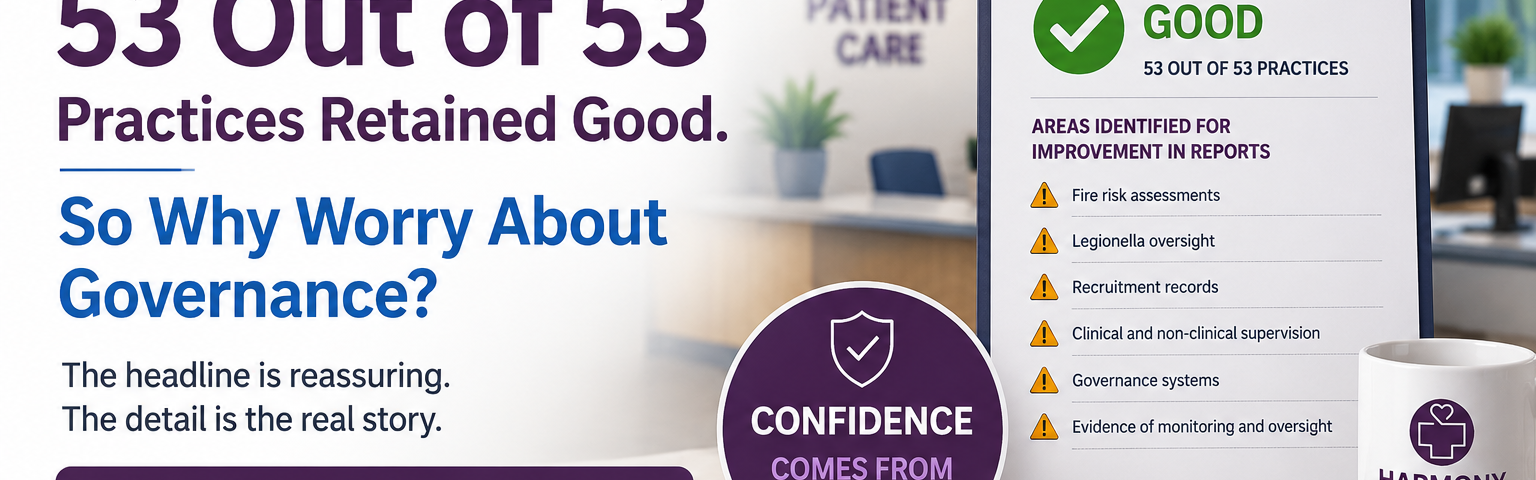
So far, 53 reports have been published.
All 53 practices retained their overall Good rating.
At first glance, that sounds like great news for general practice. It also raises a fair question:
If practices are retaining Good, why should we invest time and effort in governance?
The answer lies beneath the headline.
The Hidden Risks
While every practice retained its overall Good rating, many inspections still identified areas requiring improvement.
Common themes appearing repeatedly in reports include:
- Fire risk assessments
- Legionella oversight
- Recruitment records
- Clinical and non-clinical supervision
- Governance systems
- Evidence of monitoring and oversight
In many cases, practices were able to provide evidence during the inspection or shortly afterwards, allowing them to retain their overall rating.
But that doesn’t mean the risks weren’t there.
The Danger of Assuming Everything Is Fine
The current data suggests that the odds are in practices’ favour. However, inspections are still designed to identify concerns.
At any point during a site visit, an inspector can decide that what they are seeing warrants a deeper review.
Most practices are not struggling because they deliver poor care.
They’re struggling because they cannot easily demonstrate that good care is being delivered consistently.
That’s a governance challenge.
Governance Isn’t About CQC
The biggest misconception about governance is that it’s something you do for inspectors.
Good governance isn’t about passing inspections.
It’s about giving practice leaders confidence.
Confidence that risks are being identified.
Confidence that actions are being completed.
Confidence that systems are working as intended.
Without evidence, leaders are often relying on trust and assumptions.
Trust matters. But trust alone doesn’t tell you whether processes are actually happening.
Evidence does.
Preparing for What’s Next
Today’s Returning to Good inspections focus on a limited number of quality statements.
That won’t necessarily be the case forever.
As CQC continues developing its regulatory approach, practices will need systems that can demonstrate compliance across a much wider range of requirements.
The practices that are best prepared won’t be the ones scrambling for evidence when an inspection notice arrives.
They’ll be the practices generating evidence every day as part of normal operations.
That’s where governance becomes a strategic advantage rather than an administrative burden.
Join the Free Harmony CQC Community
Governance doesn’t have to be something you tackle alone.
The Harmony CQC Community brings together GP partners, practice managers and governance leads who are committed to building confidence in their systems, strengthening compliance and delivering outstanding care.
Inside the community you’ll find practical guidance, CQC insights, governance resources and support from peers facing the same challenges.
👉 Join the free Harmony CQC Community today and start building evidence-driven confidence in your practice.