Your COSHH Self-Assessment Audit: A Gift for Confidence, Not Compliance
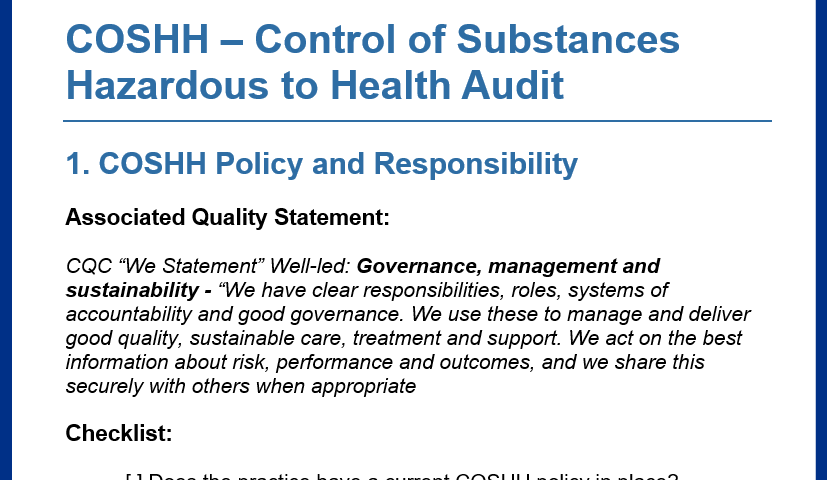
We’re sharing this COSHH self-assessment audit with you not only because COSHH compliance is essential, but because it’s a common area where practices are falling short during inspections. This audit follows the same format as the 33 others available in the Inner Circle, giving you a valuable example of how our self-assessments are designed — practical, purposeful, and inspection-ready. We’re offering it as a gift of support: to help you move from hoping things are working well to knowing they are.
That shift — from uncertainty to confidence — is exactly what the CQC looks for. Whether the audit confirms you’re already doing things in a safe and well-led way, or highlights areas for improvement, the key is having evidence. Evidence that things are working, or that you’ve recognised gaps and created an action plan to put things right. Either way, you’ll be inspection-ready with clarity, ownership, and a plan — and that’s what great governance looks like.
💡 Top tip: Give this to your COSHH lead. Let them complete it and bring their insight into a wider conversation. It’s not about checking work — it’s about building shared ownership.
Why COSHH Is Important in General Practice
In general practice, safety isn’t just about clinical care — it’s about the whole environment patients and staff interact with every day. That includes the safe storage, handling and monitoring of substances hazardous to health, such as cleaning agents, disinfectants, sanitisers and other potentially harmful materials.
The Control of Substances Hazardous to Health (COSHH) regulations are designed to protect people from harm by ensuring these substances are used responsibly and with appropriate safeguards in place. In a healthcare setting, this becomes especially important due to the vulnerable nature of many patients, the close working conditions of staff, and the frequent use of chemical products.
What the CQC Expects
COSHH practices directly support the following CQC Quality Statements under the Single Assessment Framework:
- 🟩 Safe – Safe Environments
“We detect and control potential risks in the care environment. We make sure that equipment, facilities and technology support the delivery of safe care.” - 🟩 Well-Led – Governance, Management and Sustainability
“We have clear responsibilities, roles, systems of accountability and good governance. We use these to manage and deliver good quality, sustainable care, treatment and support. We act on the best information about risk, performance and outcomes, and we share this securely with others when appropriate.”
The CQC expects practices to demonstrate that:
- All hazardous substances are identified and risk-assessed
- Staff are trained in their safe handling
- Storage, signage and spill responses meet appropriate standards
- A COSHH file is maintained and regularly reviewed
What Can Go Wrong Without COSHH?
While general practice doesn’t typically involve high-risk chemical exposure, everyday materials can still present serious risks if not managed correctly. Examples include:
- Cleaning sprays stored in patient-accessible areas
- Decanted or unlabelled disinfectants used without gloves or eye protection
- Exposure to aerosols in poorly ventilated rooms
- Failure to act after a spillage or accidental skin contact
- Incomplete or missing safety data sheets (SDS)
Even minor incidents can have significant consequences — both for staff health and for patient safety.
Common COSHH Risks in Primary Care
- Bleach or chlorine-based cleaning fluids: Skin, eye and respiratory irritation
- Surface disinfectants: Reactions or harmful exposure through open wounds or mucous membranes
- Sharps bin cleaning sprays or absorbent granules: Inhalation or improper disposal risks
- Printer toner or maintenance sprays: Respiratory hazards if aerosolised
These are all manageable risks — but only if your team is trained, equipped, and supported by good governance.
COSHH Isn’t Just a File — It’s a System
COSHH compliance is not about storing a folder on a shelf. It’s about embedding:
- Routine checks of cleaning cupboards and treatment areas
- Training for staff who use or work around chemical products
- Spill kits, PPE and signage in the right places
- Clear records of what substances are on site — and how they’re used safely
When COSHH is done well, it becomes an invisible layer of protection in the everyday running of the practice.
In Summary
COSHH compliance in general practice is not just a legal requirement — it’s a reflection of your commitment to:
- Keeping staff safe from avoidable workplace harm
- Protecting patients in all areas of the building
- Maintaining high standards of cleanliness and infection control
- Demonstrating safe and well-led governance to regulators and staff
By regularly reviewing your COSHH arrangements, your practice helps build a culture where safety, awareness and accountability are part of how everyone works — every day.
Link to the community:
https://club.hcqc.co.uk/c/self-audits/edit-lesson/sections/517637/lessons/2311056
Link to the Audit:
https://assets-v2.circle.so/mtyr6bwhi8uvieofkoz6u20b7acz