https://club.hcqc.co.uk/c/self-audits/edit-lesson/sections/517639/lessons/2310862
🔔 This is a member-generated audit.
This audit was created in response to a request from one of our Inner Circle members. We always welcome your suggestions — if there’s a topic you’d like us to explore, just let us know and we’ll create a tailored audit to support your practice.
General practice teams face the ongoing challenge of delivering high-quality care while balancing rising costs, funding variability, and increasing demand. In this context, sound financial control is not just a business requirement — it’s a key component of safe, sustainable and well-led healthcare.
This week’s audit supports practices in reviewing how effectively they manage budgets, financial responsibilities, and forecasting, helping ensure the practice remains on a stable footing now and in the future.
What the CQC Expects
This audit links directly to the Well-Led quality statement in the CQC Single Assessment Framework:
Governance, management and sustainability
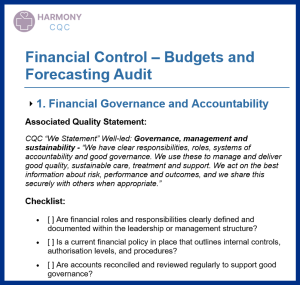
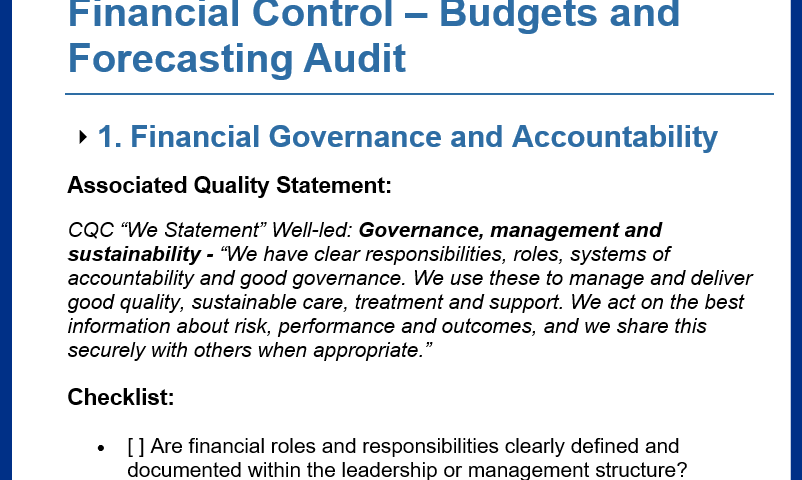
“We have clear responsibilities, roles, systems of accountability and good governance. We use these to manage and deliver good quality, sustainable care, treatment and support. We act on the best information about risk, performance and outcomes, and we share this securely with others when appropriate.”
In practical terms, this means:
- Financial roles must be clearly defined
- Budgets must be created, approved and monitored
- Income and expenditure should be regularly reviewed
- Forecasting should inform service and workforce planning
- Any financial risks must be identified and managed proactively
A well-led practice is one that has control over its finances — and can demonstrate this through documentation, review, and action.
Why It’s More Than Numbers
Robust financial control is about more than just staying out of debt. It supports:
- Planning for staffing changes, premises costs, or IT upgrades
- Responding to changes in income, such as QOF payments or DES specifications
- Avoiding overspends that could impact patient services
- Making the most of limited NHS funding by identifying where resources are most needed
When practices understand their financial position clearly, they can make faster, better decisions about services, workforce and patient care.
Common Weak Points Financial Audits Can Uncover
- Infrequent or informal budget reviews
- Lack of clarity over who is responsible for monitoring spend
- Missed opportunities to plan for income fluctuations (e.g. patient list growth, PCN income)
- Inadequate forecasting for likely cost increases (utilities, salaries, insurance)
- Spending decisions made without full financial context
This audit is designed to help uncover these issues early — and ensure controls are tightened before problems escalate.
What This Audit Helps You Explore
This structured tool enables practices to assess:
- Are financial responsibilities clearly allocated and understood?
- Is budgeting regular, informed and linked to strategic planning?
- Are forecasts being used to support long-term decision-making?
- Is financial information transparent, shared and discussed at senior level?
In Summary
Strong financial control helps general practices:
- Remain sustainable and resilient
- Plan ahead for cost pressures and income changes
- Meet their legal and regulatory obligations
- Demonstrate good governance to the CQC and wider stakeholders
By completing this audit, you’ll not only identify areas for improvement — you’ll strengthen the practice’s ability to deliver safe, consistent care backed by robust financial decision-making.