
Daniel Vincent · Harmony CQC · July 2026
At about half past ten last Monday morning, I watched a number go down — and it was one of the most encouraging things I’ve seen all year.
Let me explain.
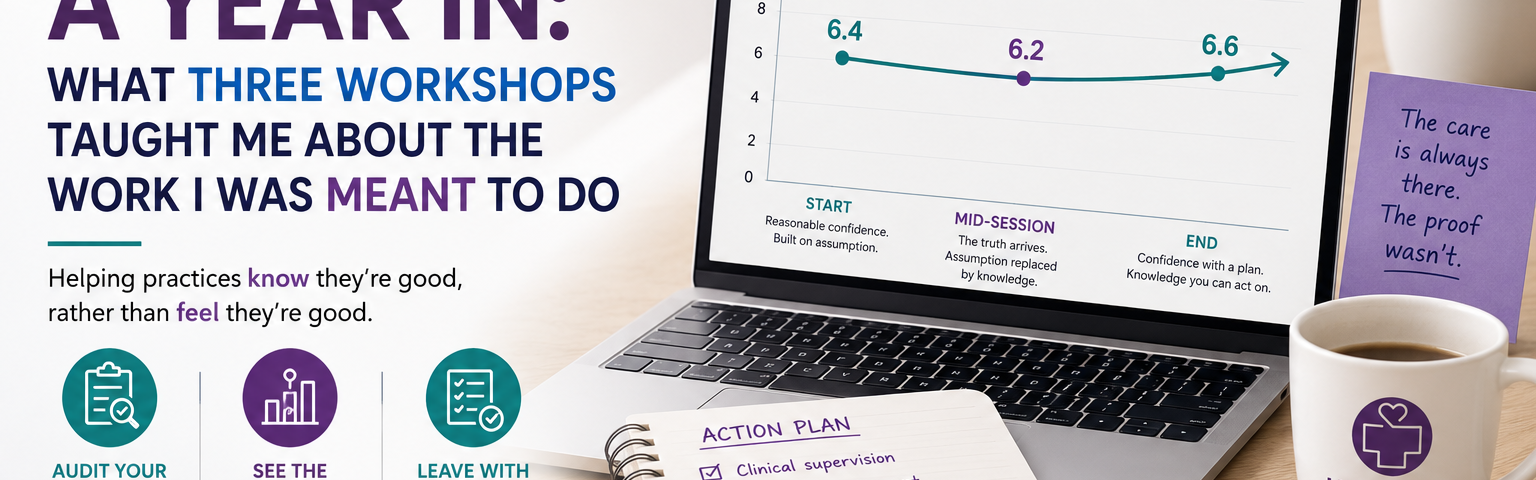
At the start of every Inspection Readiness Audit Workshop, I ask the room to score their confidence that their practice holds good evidence. Anonymous, live, on Mentimeter — nobody sees anyone else’s answer, only the shape of the room. On Monday, the room started at 6.4 out of 10. Reasonable. These are Good-rated practices, run by capable people. They should feel reasonably confident.
Then we started opening documents. Fire risk assessments. Fridge logs. Supervision records. Not talking about them — actually opening them, live, against the questions an inspector actually asks.
Mid-session, I asked the confidence question again. It had dropped. 6.2.
And I sat there, on my own in my office, talking to forty people only 12 of whom fit on my screen at any time, feeling genuinely delighted. Because that dip is the truth arriving. Confidence built on assumption was being replaced, in real time, by knowledge of the actual position. By the end of the morning the number had climbed past where it started — 6.6, and this time attached to a written action plan rather than a hopeful feeling. That little journey — 6.4, down to 6.2, up to 6.6 — is the whole of what I’m trying to do with my working life, drawn as a graph.
A year ago
It’s now a little over a year since I formally established Harmony CQC. The job title still hasn’t quite settled — trainer feels too small; consultant feels wrong, because consultants tell you things and I sit with you while you find things — so I have started describing my job by its outcome: I help practices know they’re good, rather than feel they’re good.
That distinction isn’t a slogan to me. I lived the gap between those two words.
I managed practices for twelve years. My practice was inspected three times. Two of those inspections went well. One of them didn’t — and the rating that came out of it was Inadequate. I have sat in the meeting where that word is read out to a team of people who came into work that morning believing, correctly, that they cared for their patients well. I have watched what that word does to good people. And I spent the eighteen months that followed leading the practice back to Good — which is where I learned, the hard and permanent way, that the distance between Inadequate and Good was never about the care. Our care didn’t transform in those eighteen months. Our ability to evidence it did. The systems, the records, the loops that close, the learning that gets written down. The care was always there. The proof wasn’t.
When I founded Harmony, that was the entire premise. Practices don’t fail inspections because their care is poor. They fail because they can’t prove it isn’t — and almost nobody tells them that in a way they can act on before the letter arrives.
Why a workshop, and not a course
Here’s a confession from my practice manager years: I sat through a great deal of training that washed over me entirely. Someone presented slides about what good looks like. I nodded. I went back to the practice, the phones were on fire, and nothing changed — because at no point had the training made contact with my documents, my fridge log, my staff files.
So when I designed the Inspection Readiness Audit Workshop, I designed it as the training I needed on my worst day and never got. You don’t watch me audit a fictional practice. You audit yours. Live. With your own systems open in front of you, while I supply the one thing you can’t generate from inside your own building: the inspector’s questions, drawn from every published Returning to Good report I could get my hands on.
And then there’s the part I’ve fallen completely in love with, which I didn’t fully anticipate: because everyone is auditing live, we can measure the room live. Anonymously — that’s sacred; only you ever see what you found, the room only ever sees the aggregate shape — but genuinely. When the fire risk assessment item lands, I watch the room’s honest RAG results appear on screen within a minute. When we hit clinical supervision, I watch the shape of a problem emerge across thirty practices simultaneously.
Twelve years as a PM taught me to distrust training that can’t show its working. This format shows its working every ten minutes. I can tell you — not guess, tell you — what happened in the room, because the room told me, in numbers, as it happened.
What three rooms taught me
We’ve now run the workshop three times: the third of June, the eighteenth of June, and last Monday, the sixth of July. Three different rooms, seventy-one practice bookings between them, almost all rated Good, some Outstanding.
Some things I now know, rather than believe:
Nobody goes all-green. On Monday, twenty-nine practices completed the audit across the core evidence items. The number who rated green on everything was zero. Twenty-eight of the twenty-nine found at least one red — a genuine, inspection-relevant gap they didn’t know about at nine o’clock that morning. And three-quarters of everything the room examined generated an action. These are Good practices. This is what the evidence layer of general practice actually looks like when you check it honestly, and I don’t think anyone has been showing practices this mirror.
Clinical supervision catches everyone. Three workshops, three rooms, one identical result: supervision records are the weakest item every single time. On Monday, one practice in twenty-seven rated green, and thirteen couldn’t produce a record at all. And here’s what moves me about it — it’s almost never that supervision isn’t happening. The conversations happen. The mentoring is real. It’s simply invisible on paper, which to an inspector is the same as absent. Rooms full of people supporting their clinicians every week, unable to prove a minute of it. If I achieve nothing else this year, teaching general practice to write down the good it already does would be enough.
The feelings move as much as the numbers. I ask for one word at the start and one at the end. Monday’s opening words: anxious, apprehensive, stressed, nervous — twenty-one of thirty-three people arrived somewhere on that spectrum. The closing words: empowered, relieved, clear, hopeful. My favourite of the day was “hot but hopeful,” which in a July heatwave felt like the most honest sentence in England. And one attendee’s entire closing feedback read: “I only had 2 greens.” She wasn’t complaining. She was reporting a discovery — and she left with a plan for the other ten items. That’s the trade the workshop offers: you’ll probably feel worse at half past ten than you did at nine. You’ll feel better at noon than you have in months, because the dread will have become a list, and a list is just work, and work is something practice managers know how to do.
The scale of it
Here’s the reflection I keep returning to, a year in.
As a practice manager, on my best day, I could make things better for one practice — one patient list, one team. It was good work and I was proud of it. But it had a ceiling, and the ceiling was me.
Last Monday, twenty-nine practices were in the room for a single morning’s session. Across the three workshops, we are now measurably supporting more practices in a month than I could have impacted in a decade of practice management. And every one of those practices is a patient list — thousands of people who will never know these sessions happened, but who are a little safer because a fridge exception now gets annotated, a supervision log now exists, an emergency drugs risk assessment now has a signature on it.
I don’t say that to sound grand. Most of what we fix is profoundly unglamorous. But unglamorous is where patient safety actually lives, and I’ve stopped apologising for finding meaning in fridge logs.
The experiment we’re running this summer
One more reflection, because it’s live right now and I genuinely don’t know how it will turn out — which is exactly why I want to write it down.
After three workshops, the feedback taught us something about time. Attendees loved the session and consistently wanted more room to work — more time on their own documents, less pressure to keep pace. So for the September workshop we’ve changed the shape of the thing: everything now unlocks the moment a practice books. The workbook, the preparation materials, the full audit resources — instantly, weeks ahead. The idea is that the summer becomes the course, taken at whatever pace a working practice can manage, and the live session in September becomes the consolidation: the place you firm up what you found, unstick what stuck, and finish.
And if the summer runs away with you — school holidays, locum gaps, life — the live session still carries you through the whole audit from scratch. Two doors, same room.
Will practices actually use a head start, or does the work only happen when we’re together and the clock is running? I honestly don’t know — though there’s an early signal I like: three practices already booked for September chose to join Monday’s session too, getting their heads into the work two months before their own workshop. It’s the first format decision we’ve made that the live Menti data can’t answer in advance — we’ll only know in September, when I ask a new room how many arrived with their audit already begun. A year ago that uncertainty would have worried me. Now it just feels like the next thing the rooms will teach me. They haven’t been wrong yet.
A year in
So that’s where I am, twelve months into this. Still slightly amazed that the thing I built out of my worst professional experience has become one of the most useful things I’ve ever made. Still moved, every single session, by the honesty of practice managers who will type “our survey is shocking and we have no plan” into an anonymous box at half past eleven and leave at noon with the plan started. Still convinced of the simple idea underneath all of it: that the practices of this country are, overwhelmingly, better than they can currently prove — and that closing that gap is some of the most worthwhile work there is.
To everyone who has sat in one of those three rooms: thank you. You think you’re attending training. From where I sit, you’re building the evidence base — live, anonymously, honestly — that is teaching all of us what general practice actually needs.
The numbers went down before they went up. That’s how you know they’re real.
Daniel