
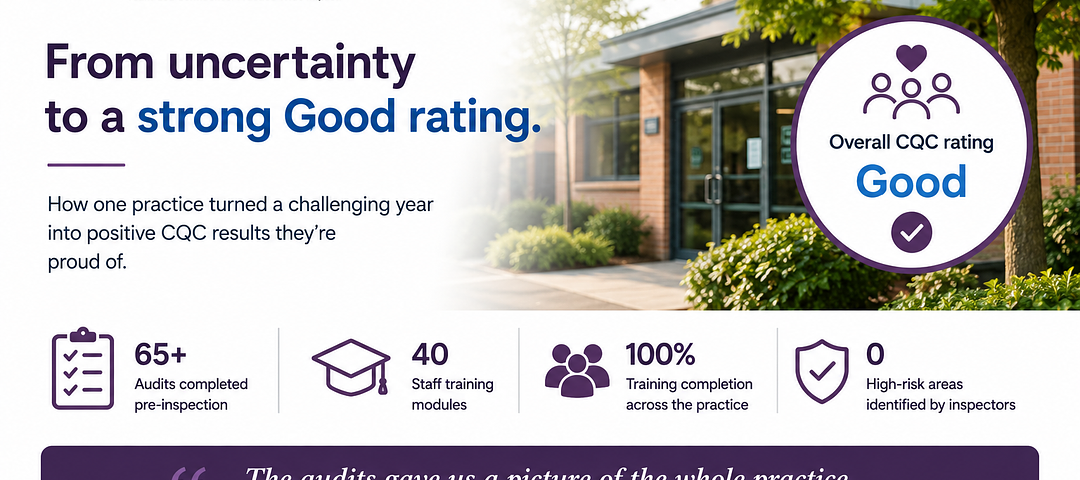
When Spring Gardens Group Medical Practice found itself with a practice manager vacancy, a data breach, and inaccessible governance documents, the news that CQC was inspecting in Worcester felt like a nightmare waiting to happen. Here’s how they turned one of the most stressful years of their careers into a strong Good rating and a result they’re proud of.
A CONVERSATION WITH DR CLAIRE JONES, GP PARTNER
Spring Gardens Group Medical Practice, Worcester
Dr Claire Jones, GP Partner at Spring Gardens, has worked at the practice since 1998. She’s seen a lot. But when we spoke recently, she was candid about how the past year had felt: the most stressful of her entire career.
What makes her story worth telling isn’t the stress — it’s what she did about it, and what happened on the other side.
The problems had been building quietly over several years, creating a significant backlog of governance work. When the practice migrated its documents to SharePoint, neither partners nor staff were able to access documents with confidence. A data breach prompted the team to look more closely at what was happening across the practice, and what they found caused further concern.
“We had no vision or mission statement, training was lax, HR files were incomplete and important documents were difficult to find. We had 148 years of combined Spring Gardens experience between eight partners, and we were all motivated to take control.
“I said, if CQC come in now, we are in real danger of getting inadequate for leadership — because we have scant documentation, we’ve been moved onto SharePoint, and nobody has had access for months.”
DR CLAIRE JONES, GP PARTNER, SPRING GARDENS GROUP MEDICAL PRACTICE
With a practice manager vacancy to fill and no clear timeline for when it would be resolved, the eight partners divided management responsibilities between themselves. There was a natural division of roles and Dr Jones took on compliance — because someone had to, and because she could see the scale of what needed doing.
“We don’t know what we’re doing,” she told her colleagues at the time.
Then she caught herself.
“Actually, we do know what we’re doing. We just don’t know where anything is.”
The partners knew they had a responsibility to 20,000 patients and 50 staff to provide a high-quality service.
The Audit That Changed Everything
In March of last year, Spring Gardens began working through the CQC Clarity programme.
Dr Jones completed 65 audits alongside her staff and discovered that people had been working hard within their own areas but without any shared framework to bring everything together.
“Every audit we opened, it was, ‘No, we don’t have a policy for that,’ or, ‘No, we’re not doing that’ — not because people weren’t trying, but because there was no structure connecting everyone’s efforts.”
The process exposed gaps that would have been invisible without it. Notice boards advertising a Facebook page the practice hadn’t run for two years. Notes stored incorrectly. Blood pressure machines being given away rather than loaned to patients.
Small things, every one of them — exactly the kind of things inspectors walk straight to.
Key Preparation Statistics
65+ Audits completed pre-inspection
40 Staff Training Modules. 100% Completion
0 High-risk areas identified by inspectors
When CQC activity started increasing in Worcester, Spring Gardens had some time on its side. Other practices were generous in sharing their inspection experiences and emphasised the importance of rigorous preparation: audits, evidence, Ardens searches and documented improvement activity.
The practice spent an entire year preparing.
“We looked into every corner and every detail of the practice, recording our improvement journey through the audits.”
The team prepared evidence on every patient group as well as teaching, training and research activities.
When CQC’s document request arrived, the scale of what was required became clear.
“Even with everything prepared, it was a huge amount of work to submit. It would have been impossible to generate these documents at one week’s notice.”
When inspectors requested evidence of nursing audits, the practice was able to immediately provide ten completed CQC Harmony Community Audits.
The Day of the Inspection
Dr Jones had prepared a presentation for inspectors six months earlier, updating it as the inspection approached. She knew it inside out.
She printed copies for the inspection team and prepared supporting appendices so inspectors could focus on understanding the practice rather than taking notes.
“I wanted to show them all the quality work we do.”
One of the most human moments came from the nursing team.
Several nurses were nervous about speaking with inspectors. One even filled her admin session with patients in the hope she’d be too busy to be approached.
Dr Jones highlighted this in her presentation and actively encouraged inspectors to spend time with the nursing team because she knew they represented the values of the practice.
They did.
And they spent a long time with them.
“When they arrived, I thought: there is no one here who doesn’t want today to go well. Every single person in this building is behind us.”
DR CLAIRE JONES
Inspectors noted the 40 mandatory training modules completed by the practice, with 100% compliance across the workforce.
They praised the nursing team’s work supporting homeless patients with leg ulcer care. They commended the care provided to 120 asylum seekers living in accommodation next door to the practice. They also appreciated the presence of the Patient Participation Group during the inspection presentation itself — something inspectors said they had never seen before.
The PPG, including members who had attended the previous CQC inspection in 2016, were robustly supportive. Their presence in the room — genuine, unprompted and vocal — said something no presentation could have achieved on its own.
What the Inspectors Found
The feedback on the day was largely positive.
Medicines management: good.
GP consultation reviews: positive.
Safe handling reviews: no high-risk concerns identified.
The few issues raised were relatively minor. The PSDs for healthcare assistants administering B12 injections required strengthening. One low-risk administrative task had remained open for four weeks. A clinical waste bin had been left unlocked and some clinical rooms required pedal bins with lids. Inspectors also identified a need for more consistent reviews of asthma patients following steroid treatment.
These were all areas the practice was already aware of and has since addressed.
When the formal report arrived, Spring Gardens retained its overall Good rating.
CQC Scores
Safe: 72%
Effective: 71%
Caring: 80%
Responsive: 82%
Well-Led: 79%
A Good practice scores between 63% and 87%, meaning Spring Gardens achieved strong Good scores across all five domains.
Across the 34 Quality Statements assessed by CQC, the practice achieved:
- 28 Quality Statements rated Good
- 2 Quality Statements with minor shortfalls
- 4 Quality Statements rated Exceptional
The four exceptional ratings reflected areas the practice is particularly proud of.
Inspectors highlighted the nursing team’s work caring for homeless patients through Maggs Day Centre, the support provided to asylum seekers, the practice’s work tackling health inequalities, and its strong culture of research, teaching, training, learning, improvement and innovation.
The report also recognised:
- Strong medicines management
- Extensive use of audits and re-audits
- Autism Friendly Practice initiatives
- The contribution of the Patient Participation Group
- A culture of continuous improvement
“We thought it was a much more pleasant experience compared to the nightmare we’d been expecting. The inspectors were kind on the day, genuinely interested in the practice and put us all at ease.”
Looking back now, with the report published and a strong Good rating confirmed, the year of sleepless nights, Sunday evenings spent reviewing medications, audits, cleaning schedules and notice board checks had been worth it.
“Much of the work has helped the practice modernise and improve. Some of it has given us a few more grey hairs.”
What Made the Difference
If you ask Dr Jones what the CQC Clarity programme actually gave her, she doesn’t talk about the platform first.
She talks about structure.
“Without the compliance tools, people were working really hard at their jobs — but just doing their own thing, doing what they thought was important. The audits gave us a picture of the whole practice, not just the bits each person looked after.”
The 75 audits Spring Gardens completed weren’t checkbox exercises. They were how a practice navigating a period of genuine difficulty found its footing again. They gave Dr Jones a defensible evidence base. They gave the team a shared language around what “good” looked like. And they gave inspectors what every inspector is looking for: a practice that doesn’t just claim to be well-led, but can show it.
Dr Jones is already thinking about what comes next.
There are still audits within the programme she plans to complete. Governance remains firmly on the agenda for future practice meetings. She knows the framework needs to continue — not because another inspection is imminent, but because standards can slip when focus is lost.
“The audits are so highly relevant,” she says.
“I need to do them. Not because CQC are coming — but because the practice needs them.”
Spring Gardens Group Medical Practice serves the Worcester area. Dr Claire Jones is a GP Partner at the practice and has worked there since 1998.
Start building your CQC confidence with a system that works for you – not against you.