https://club.hcqc.co.uk/c/self-audits/edit-lesson/sections/517639/lessons/2909340
Behind every diagnosis, referral, and recall is a code — a digital snapshot of patient care.
Clinical coding may feel like an administrative task, but it’s one of the most important foundations of safe, high-quality healthcare.
When coding is accurate, complete, and consistent, it ensures that patients are correctly identified for reviews, clinicians make safe decisions, and the practice meets both contractual and regulatory expectations.
When coding is inaccurate or inconsistent, safety-netting can fail — and patients can be missed.
Why This Audit Was Created
This week’s audit focuses on Clinical Coding Accuracy and Consistency, in line with:
- Regulation 12: Safe care and treatment
- Regulation 17: Good governance
- Regulation 18: Staffing
And the following CQC “We” statements:
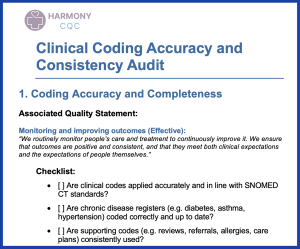
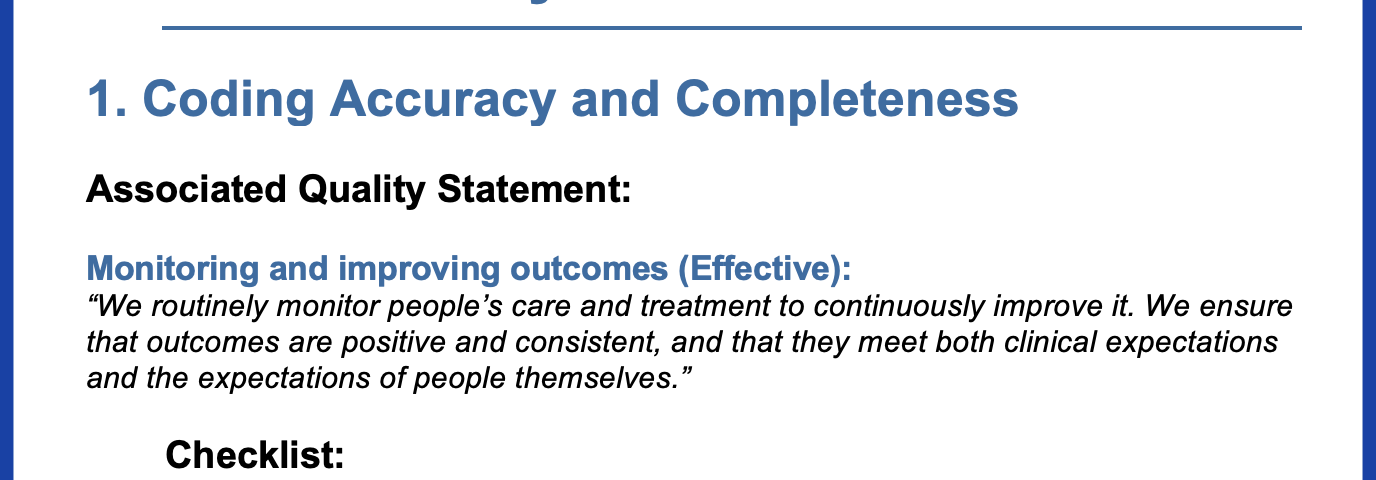
- Monitoring and improving outcomes (Effective)
- Learning, improvement and innovation (Well-led)
- Governance, management and sustainability (Well-led)
The audit helps practices ensure that clinical data is reliable, consistent, and reflective of the care provided — forming a solid base for patient safety, QOF compliance, and continuous improvement.
Why It Matters
- Patient safety: Correct coding ensures that recalls, reviews, and safety-netting processes capture the right patients at the right time.
- Data integrity: Accurate codes provide reliable evidence for clinical decision-making and performance monitoring.
- Governance and assurance: CQC inspectors expect practices to demonstrate strong data governance, accountability, and learning systems.
- Team efficiency: Consistent coding standards reduce confusion, duplication, and errors across teams.
What Good Practice Looks Like
- All staff use standardised coding protocols and SNOMED CT-compliant templates.
- Long-term conditions, reviews, and investigations are coded accurately and consistently.
- Data quality audits are carried out regularly, with errors corrected and learning shared.
- There is a nominated coding or data quality lead responsible for oversight.
- Coding accuracy is discussed in governance meetings and included in staff training.
Final Thoughts
Accurate coding is the backbone of safe, effective, and well-led general practice. It ensures patients are never overlooked, outcomes are monitored accurately, and the practice can evidence its quality of care.
By completing this audit, practices can:
- Strengthen patient safety through accurate data and recall systems.
- Support consistency, collaboration, and continuous improvement among staff.
- Demonstrate robust governance and compliance with CQC expectations.
Every code tells part of the patient’s story — getting it right means getting care right.
Click the link below to join our Inner Circle today for just £1 for your first month and unlock full access to every CQC audit — your essential toolkit to feel fully prepared and inspection ready! 👇