https://club.hcqc.co.uk/c/self-audits/edit-lesson/sections/517639/lessons/2909588
When a patient dies, general practice plays an important role in ensuring their memory is treated with dignity, their information handled lawfully, and their family supported with compassion.
Even small administrative tasks — such as closing a record, cancelling appointments, or returning property — carry deep emotional and professional significance.
How these moments are managed reflects the practice’s culture of respect, care, and professionalism.
Why This Audit Was Created
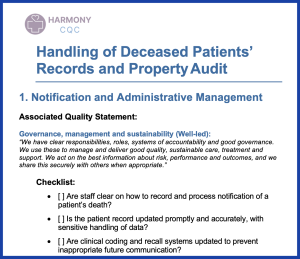
This week’s audit focuses on Handling of Deceased Patients’ Records and Property, in line with the following CQC regulations:
- Regulation 10: Dignity and respect
- Regulation 9: Person-centred care
- Regulation 17: Good governance
And the following CQC “We” statements:
- Kindness, compassion and dignity (Caring)
- Treating people as individuals (Caring)
- Governance, management and sustainability (Well-led)
The audit helps practices ensure that every aspect of bereavement handling — from data management to family communication — is conducted with both sensitivity and accuracy.
Why It Matters
- Respect for patients and families: Every interaction following a death should be handled with care, empathy, and professionalism.
- Data protection and confidentiality: Patient records must be updated and closed promptly to prevent errors or breaches.
- Professional accountability: Practices must demonstrate clear, lawful processes for managing information and property.
- CQC assurance: Sensitive and well-governed bereavement processes are key indicators of a caring and well-led service.
What Good Practice Looks Like
- Patient records are updated promptly, coded accurately, and removed from recall or correspondence lists.
- Staff follow clear guidance on what can be shared with families and representatives.
- Property or documentation is handled securely, recorded, and returned with respect.
- Families receive compassionate communication, and staff are confident in managing sensitive conversations.
- Bereavement processes are reviewed in governance meetings to ensure continuous learning and improvement.
Final Thoughts
How a practice handles the death of a patient says as much about its culture as how it delivers care to the living.
It’s a moment that calls for precision, sensitivity, and humanity — all at once.
By completing this audit, practices can:
- Ensure legal, respectful, and consistent processes are in place.
- Support staff in managing difficult administrative and emotional moments.
- Demonstrate to regulators and families alike that compassion continues beyond the patient’s final appointment.
Caring doesn’t end at the point of death — it extends into how we honour patients and support those they leave behind.
Click the link below to join our Inner Circle today for just £1 for your first month and unlock full access to every CQC audit — your essential toolkit to feel fully prepared and inspection ready! 👇