https://club.hcqc.co.uk/c/self-audits/edit-lesson/sections/517639/lessons/2175561
In the day-to-day operations of general practice, handling clinical samples may seem like a routine task — but behind every blood tube, swab, or urine pot is a patient waiting for an answer. Ensuring that samples are collected, labelled, stored, and transported safely is not only a basic operational requirement — it’s a clinical safety responsibility.
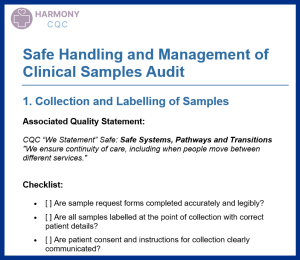
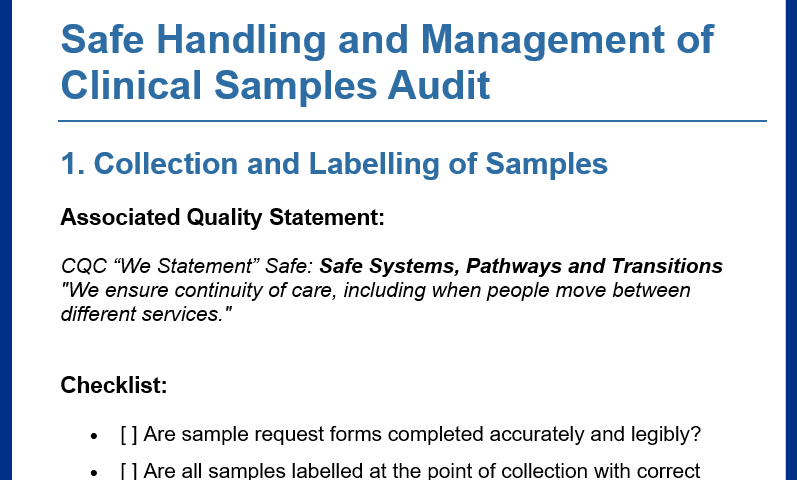
This week’s audit supports practices to review how well they manage clinical samples — from the point of collection to their safe arrival at the laboratory.
Why This Matters: Small Mistakes, Big Consequences
Sample handling errors are more common — and more serious — than many realise.
A simple mislabelling, storage delay, or miscommunication with the lab can lead to:
- Missed or delayed diagnoses
- Patients having to repeat unpleasant or invasive tests
- Incorrect treatment decisions
- Wasted NHS resources and duplicate appointments
- Patient harm and loss of trust
This audit gives your team a structured way to proactively check that risks are being identified, managed, and minimised.
How It Supports CQC Compliance
The Care Quality Commission’s Single Assessment Framework includes clear expectations around safety, governance, and infection control. This audit links directly to key ‘We’ statements, including:
- ✅ Safe – Safe Systems, Pathways and Transitions
“We work with people and our partners to establish and maintain safe systems of care, in which safety is managed, monitored and assured.” - ✅ Safe – Safe Environments
“We detect and control potential risks in the care environment. We make sure that equipment, facilities and technology support the delivery of safe care.” - ✅ Safe – Infection Prevention and Control
“We assess and manage the risk of infection. We detect and control the risk of it spreading and share concerns with appropriate agencies promptly.” - ✅ Well-Led – Governance, Management and Sustainability
“We have clear responsibilities, roles, systems of accountability and good governance.”
This audit helps practices demonstrate that they’re meeting these standards through practical, inspectable processes.
What the Audit Helps You Identify
- Are samples consistently labelled, logged, and tracked?
- Are cold chains (e.g. fridges, courier times) being maintained?
- Are infectious samples handled with appropriate precautions?
- Are there any patterns in sample rejections or lab errors?
- Are staff confident in their roles and up to date on protocols?
It’s Also About Culture and Communication
Sample safety is a team effort.
It involves:
- Admin staff receiving and preparing samples
- Nurses and HCAs collecting them
- GPs reviewing results
- Couriers transporting them
- Labs processing them
This audit encourages cross-role awareness, shared responsibility, and regular communication — which are the foundations of any safe clinical process.
In Summary
Clinical sample handling may not get the same attention as prescribing or diagnostics — but it is just as important for safe, timely, high-quality patient care.
By completing this audit, you can:
- Reduce delays and errors
- Improve patient experience and outcomes
- Strengthen communication with your local lab
- Provide clear evidence of CQC compliance
- Support training, governance, and safer systems
👉 Use this week’s audit to identify what’s working well — and where small improvements could make a big difference.