https://club.hcqc.co.uk/c/self-audits/edit-lesson/sections/517638/lessons/2029016
In general practice, delivering personalised, inclusive care isn’t just good clinical practice — it’s a legal and ethical obligation. One of the most important ways practices can meet this responsibility is by recognising and responding to patients who need reasonable adjustments to access care safely and effectively.
This is where the Reasonable Adjustments Flag comes in — a simple but powerful tool that helps ensure no patient is left behind.
✅ What Are Reasonable Adjustments?
Reasonable adjustments are changes that healthcare providers must make to remove or reduce barriers for patients with a disability or additional need. Under the Equality Act 2010, this is not optional — it’s a legal requirement.
Examples include:
- Offering longer appointments for patients with learning disabilities
- Providing information in large print, braille, or easy-read formats
- Scheduling quieter appointments for patients with autism
- Ensuring an interpreter or carer is present when needed
- Adjusting communication style for those with cognitive impairments or hearing loss
🔍 Why Is the Flag Important?
The Reasonable Adjustments Flag is a specific, visible record within the patient’s clinical notes that alerts all team members to their identified needs — and how to meet them.
Without it:
- Staff may miss vital information
- Patients may face unnecessary distress or delays
- The practice may be non-compliant with national guidance (e.g., the Accessible Information Standard)
With it:
- Adjustments are consistently recognised and actioned
- Communication is clearer and care more accessible
- Patients feel seen, heard, and respected
- It demonstrates clear evidence for the CQC’s ‘Equity in Access’ and ‘Person-Centred Care’ quality statements
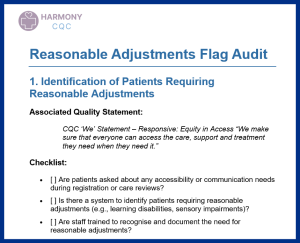
🛠 What Does the Audit Do?
This audit supports practices to:
- Ensure that patients are identified and flagged appropriately
- Check that flagged adjustments are recorded accurately and acted upon
- Assess whether staff are trained and confident in meeting accessibility needs
- Evaluate patient feedback on how well their needs are being met
- Provide inspectable evidence that the practice is delivering equitable care
Each section links directly to the CQC’s updated single assessment framework, including:
- Equity in Access
- Providing Information
- Person-Centred Care
- Workforce Equality, Diversity and Inclusion
- Partnerships and Communities
🩺 Why This Matters in Practice
Patients who need reasonable adjustments are often some of the most vulnerable in our care. If their needs are missed, the consequences can be serious — including misdiagnosis, non-attendance, or health deterioration.
When adjustments are recorded and consistently acted upon, practices can:
- Reduce missed appointments and improve health outcomes
- Build trust with patients who might otherwise disengage
- Support staff with clear guidance on how to respond
- Demonstrate a strong commitment to inclusion, safety, and dignity
💬 In Summary
The Reasonable Adjustments Flag isn’t just a tick-box — it’s a lifeline for equitable care.
By completing this audit, your team can reflect on what’s working well, identify gaps, and make practical improvements that truly change patient experiences for the better.
It’s not just about compliance — it’s about compassion, clarity, and commitment to accessible healthcare for all.