
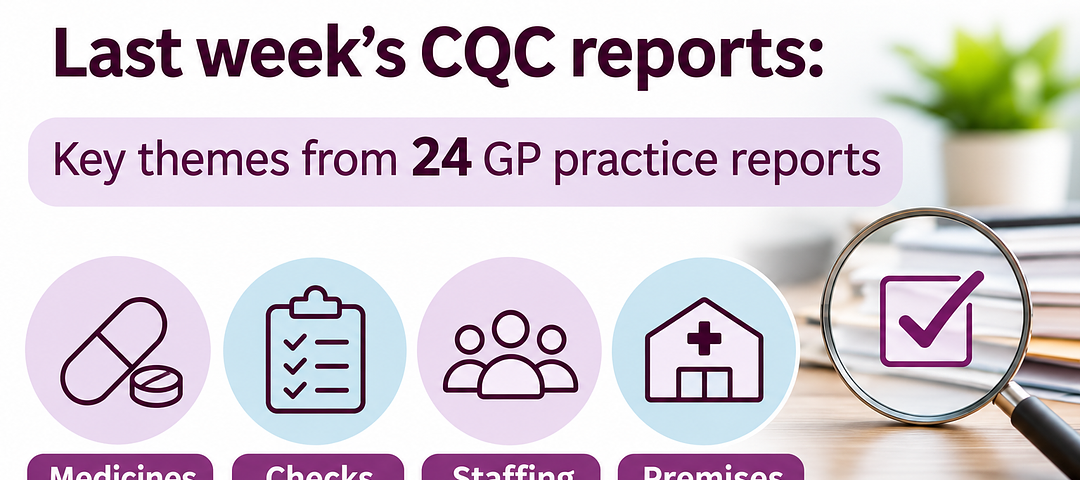
THE WEEK AT A GLANCE
– 24 reports on GP practices published by CQC. Every one carried a rating.
– All 24 rated Good (24 of the 24 rated reports).
– One rating moved up, from Requires Improvement to Good, and none moved down. 21 kept their previous rating, and 2 were for practices with no earlier rating.
– 10 of the 24 included at least one statement scored below Good.
– 22 of the 420 statements scored (5%) fell below Good.
– 5 of the 24 had at least one statement scored at Outstanding level.
A Good rating does not mean every area was Good. Most of the findings below came down to systems that are easy to overlook.
THE FINDINGS TO LEARN FROM
Medicines
Medicines for autoimmune conditions: dosing day not recorded
Medicines optimisation · scored at Inadequate level
CQC carried out a clinical search of people prescribed a medicine used to treat autoimmune diseases, such as rheumatoid arthritis, psoriasis and Crohn’s disease, and certain cancers. Some people had not been advised which day of the week the medicine should be taken, and it was not recorded on the repeat prescription template. The CQC inspection report said this was “not in line with Medicines and Healthcare products Regulatory Agency’s (MHRA) safety guidance”.
Long-term bisphosphonates: 49 of 52 patients had no bone density scan in five years
Delivering evidence-based care and treatment · scored at Requires Improvement level
CQC carried out a clinical search of patients prescribed bisphosphonates for 5 years or more, to see whether appropriate reviews had been carried out. Bisphosphonates are medicines used to strengthen bones, reduce bone loss and lower the risk of fractures. The search found 52 patients, of whom 49 had not had a DEXA scan within the previous 5 years to assess bone mineral density and ongoing treatment need.
Staffing
Professional registration: checked at recruitment, then not monitored
Safe and effective staffing · scored at Requires Improvement level
The practice checked professional registration with bodies such as the GMC and NMC at recruitment, but did not have an ongoing system to monitor continuing registration. For nursing staff, registration checks were only carried out as part of the three-year revalidation process.
Premises
Hand sanitiser and other clinical products: data sheets on file, but no risk assessment
Safe environments · scored at Requires Improvement level
The practice had not completed a risk assessment for clinical products used by staff, such as alcohol-based hand sanitiser. When CQC raised this, the practice supplied safety data sheets for the products but no risk assessment.
Emergency equipment: behind controlled doors staff struggled to open
Safe environments · scored at Requires Improvement level
Access to emergency equipment was restricted by controlled doors. The CQC inspection report noted “during the inspection we observed staff had difficulty gaining access”.
WHAT GOOD LOOKED LIKE
There was plenty to be encouraged by. 5 of the 24 rated reports had at least one statement scored at Outstanding level. Three examples:
Helping patients whose health affects their work
Supporting people to live healthier lives · scored at Outstanding level
The practice worked with PCN partners to support people whose health conditions were affecting their ability to work. Through the Fit Note Innovation Pilot, people could access Work and Health Coaches, who provided personalised support including advice about employment, health and reasonable workplace adjustments.
Letting young people decide how involved their parents are
Kindness, compassion and dignity · scored at Outstanding level
Staff understood Gillick competency, and there was a process to make sure “young adults had control over their own privacy and the amount of parental involvement in managing their care and support”.
Asking patients to give feedback to CQC
Kindness, compassion and dignity · scored at Outstanding level
25 people contacted CQC after the practice displayed CQC’s posters asking for feedback. People described the service as exceptional and said staff listened, were kind and provided fantastic care.
CHECK YOUR OWN SYSTEMS THIS MONTH
None of last week’s findings required anything unusual. They came from routine searches, checks and walk-throughs. Each is something your practice can test for itself:
– Run your own clinical searches
– Set up regular registration checks
– Review your hazardous substance assessments
– Try reaching your emergency kit as a member of staff would
Would your practice come out well if CQC ran the same searches tomorrow? It’s worth taking a little time this month to find out.
Want to talk it through with others doing the same? Join our free community at https://1.hcqc.co.uk, where you can share what you found and see how other practices are tackling it.