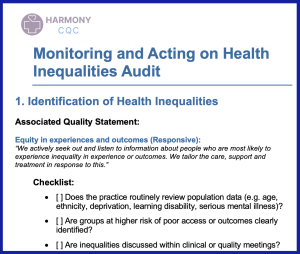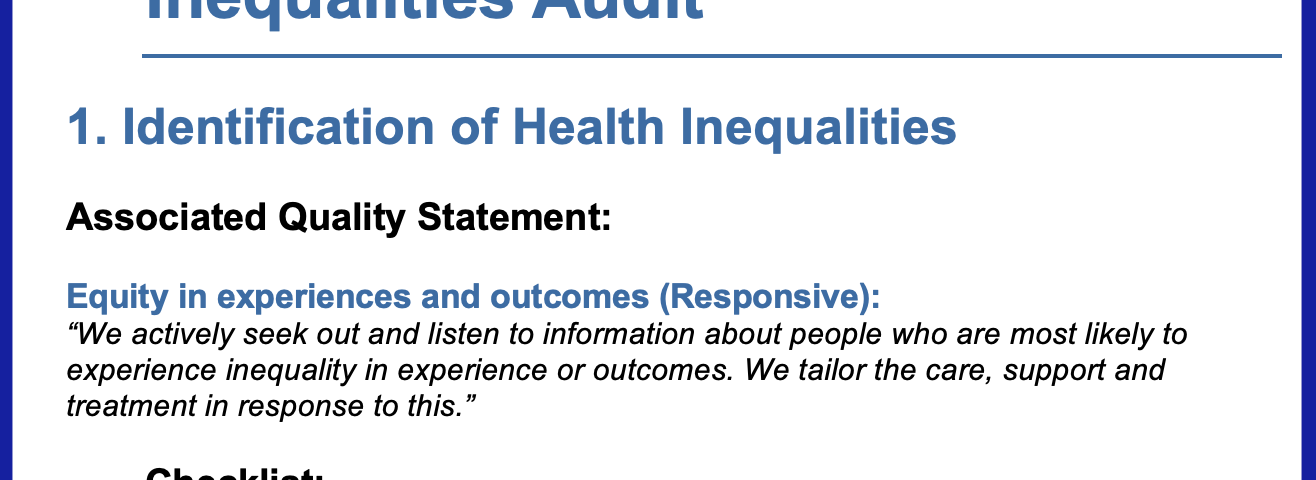
Download the Audit here: Monitoring and Acting on Health Inequalities Audit
Health inequalities are not abstract policy concepts, they are visible every day in general practice. Differences in access, experience, and outcomes are shaped by factors such as deprivation, disability, language barriers, digital exclusion, mental health, and long-term conditions.
General practice sits at the front line of tackling these inequalities. How well practices understand their population, adapt services, and act on data is now a key focus for CQC inspections under the Responsive, Effective, and Well-led domains.
Why This Audit Was Created
This week’s audit focuses on Monitoring and Acting on Health Inequalities, aligning with the following CQC “We” statements:
- Equity in experiences and outcomes (Responsive)
- Assessing needs (Effective)
- Governance, management and sustainability (Well-led)
The aim is to help practices move beyond good intentions and demonstrate clear, evidence-based action to reduce inequalities in care delivery and outcomes.
Why This Matters in General Practice
Understanding your population
CQC expects practices to know who their patients are – not just in numbers, but in need. This includes identifying groups more likely to experience barriers to care or poorer outcomes, and understanding why.
Turning data into action
Data alone is not enough. Practices are expected to show how insights from population health data, clinical systems, and patient feedback lead to practical changes, such as targeted outreach, flexible access, or reasonable adjustments.
Equitable access and outcomes
Offering the same service to everyone does not always result in fair outcomes. Equity means adapting how care is delivered so that patients with greater need receive the right level of support, in the right way, at the right time.
Strong governance and leadership
CQC inspectors increasingly look for evidence that inequality work is embedded into governance, rather than treated as a one-off project. Clear ownership, regular review, and shared learning all demonstrate a mature, well-led organisation.
What Good Practice Looks Like
- Population data is routinely reviewed and discussed
- Groups at higher risk of inequality are clearly identified
- Targeted actions are in place and reviewed for impact
- Communication and access are adapted to meet diverse needs
- Learning and outcomes are monitored and shared
Final Thoughts
Reducing health inequalities is one of the most meaningful contributions general practice can make to improving population health. It requires curiosity, reflection, and a willingness to adapt services to meet people where they are.
By completing the Monitoring and Acting on Health Inequalities Audit, practices can demonstrate that they:
- Understand their community
- Act on evidence and insight
- Deliver equitable, person-centred care
- Meet CQC expectations with confidence
This audit supports practices to show that equity is not an aspiration – it is an active, ongoing part of how care is planned and delivered.
Click the link below to join our Inner Circle today for just £1 for your first month and unlock full access to every CQC audit — your essential toolkit to feel fully prepared and inspection ready! 👇