https://club.hcqc.co.uk/c/self-audits/edit-lesson/sections/426166/lessons/1596168
The Additional Roles Reimbursement Scheme (ARRS) has significantly expanded the workforce in primary care, enabling general practice teams to offer a broader range of services and alleviate pressure on GPs. However, with this expansion comes the responsibility of ensuring compliance, proper integration, and governance – something the CQC is increasingly scrutinising during inspections.
This article explores why auditing ARRS roles is essential, the risks of poor compliance, and how practices can ensure they are making the most of these vital roles.
Why Auditing ARRS Roles is Essential
- Compliance with Funding Requirements
The ARRS scheme provides funding for additional roles, but this funding is conditional. Practices must demonstrate that:
✔️ Roles align with the intended scope of ARRS funding.
✔️ Staff meet the required qualifications and competencies.
✔️ The practice records and reports on the impact of these roles.
Failure to comply with these conditions could result in funding clawbacks or reduced future allocations.
- CQC Scrutiny of Workforce Governance
CQC inspectors assess how effectively ARRS roles are embedded within a practice. They look for:
✔️ Clear job descriptions that outline responsibilities and scope.
✔️ Appropriate supervision and training pathways.
✔️ Evidence of impact, including patient outcomes and service efficiencies.
A lack of structure in ARRS roles may lead to concerns around governance, patient safety, and service continuity.
- Maximising the Value of ARRS Roles
Beyond compliance, auditing ARRS roles helps ensure the practice is getting the best return on investment. Without clear role definitions and objectives, there is a risk that:
- Staff may duplicate tasks that other team members are already doing.
- ARRS professionals may not operate at the top of their skill set, reducing efficiency.
- Patients and colleagues may not fully understand how to access the additional support these roles offer.
A regular audit helps optimise role deployment, ensuring these professionals contribute meaningfully to patient care.
The Risks of Non-Compliance
When ARRS roles are not well managed, there are several risks:
- Reduced funding due to failure to meet scheme conditions.
- CQC concerns around workforce management and governance.
- Underutilisation of roles, meaning the practice does not benefit fully from the scheme.
- Low job satisfaction and retention issues, leading to high turnover and recruitment challenges.
Best Practice: Embedding ARRS Roles for Success
- Regular audits to check compliance, effectiveness, and integration.
- Clear structures for supervision to support ARRS professionals.
- Defined patient pathways to ensure the roles are fully utilised.
- Staff and patient education to raise awareness of these services.
- Data-driven decision-making to evaluate impact and improve processes.
Final Thoughts
ARRS roles are a game-changer for general practice, but only if they are properly structured, monitored, and embedded into the organisation. By auditing these roles effectively, practices can ensure compliance, enhance workforce efficiency, and ultimately improve patient care.
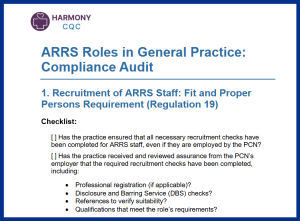
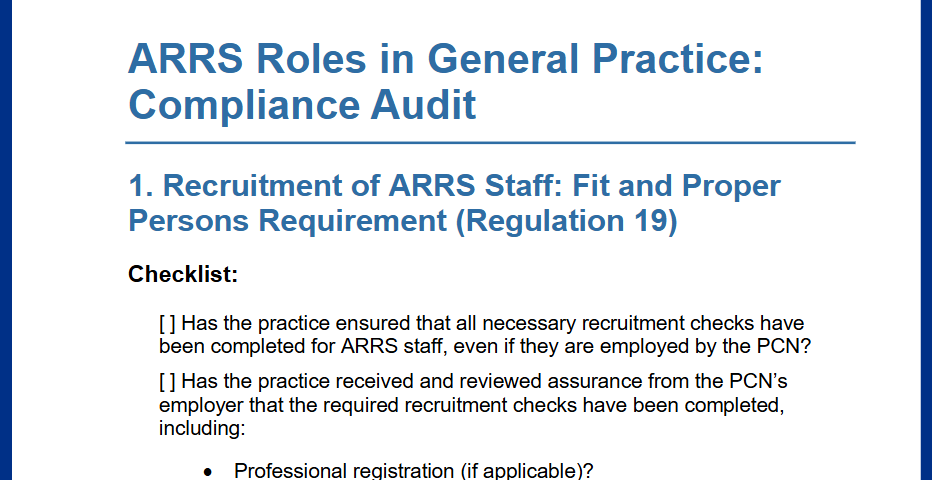
To support you in embedding ARRS roles successfully, use our ARRS Roles Audit to assess your practice’s approach and ensure you’re getting the most from these vital roles.